May 30, 2026 – Message from Heaven to Sister Beghe, France
(Reading: 3 mins)
“My Beloved Children,
Come to Me, My little children, and I will make you fishers of men.
Just as I converted Peter and the apostles—most of whom were fishermen—into fishers of men to bring them to Me and make them know God, their Savior, so I also use you, My children, to bring My Word, My Gospel, to your fellow human beings.
You read My words, and you are happy because I am God and because God always has so much to offer each of His children. He bestows His graces of conversion, His graces of sanctification, and His graces of perfection upon all who listen to Him, pray to Him, and desire to live as true Christians.
For two thousand years, the Church has experienced great moments of growth, conversions, and evangelization throughout the world, but there have been schisms, separations, and errors that have weakened its expansion.
There were the heresies of the early centuries:
- In the 11th century, there was the significant schism of the Orthodox [1], who, due to a different interpretation of the Creed, refused to recognize the authority of the successor of Peter.
- In the 16th century, there was the pride and lust of King Henry VIII of England, who led his kingdom into Anglicanism [2].
- There was the revolt of Luther and Calvin [3], who drew with them a great many gullible and rebellious people into numerous Protestant sects.
There were numerous seditions within the Holy Catholic and Apostolic Church, through which it was led, with God’s help, by the successors of Peter.
The great Council of Trent (1545–1563) [4] brought about the great Catholic consolidation and restored the discipline of the Church.
The Holy Church continued to face persecutions, fomented by infiltrated political parties or by ideological movements (free thought, liberalism, modernism…), against which the popes of the 19th and 20th centuries spoke out and condemned them.
- There was the “Syllabus [Errorum] (Compendium) of the Principal Errors of the Present Time” and the encyclical “Quanta Cura” by Blessed Pope Pius IX. [5]
- There was the great encyclical of Leo XIII on the Freemason sect, “Humanum Genus” (Human Kind) [6].
- There was “Pascendi Dominici Gregis” (Shepherding the Lord’s Flock), in which Saint Pius X denounced modernism, which, he said, could be considered the synthesis of all heresies [7].
- There was “Mortalium Animos” (The minds of mortals) [8] by Pius XI denouncing ecumenism,
- There was “Humani Generis” (The Human Race) by Pius XII against the new theology, and many other encyclicals, decrees, sermons, and expositions [9].
Then came the Second Vatican Council [10], called for by Pope John XXIII to “open the Church to the world”, and the world rushed in, even though I had said to My apostles:
“If you were of the world, the world would love its own; but because you are not of the world, —since My choice has drawn you out of the world— the world hates you” (Jn 15:19).
The new modernists of the new theology—some of whom had been formally condemned by Pius XII and whose best-known figures were
- Father Henri de Lubac
- Father Karl Rahner
- The philosopher Maurice Blondel
- Father Teilhard de Chardin
- Father Hans Urs von Balthasar
- Father Yves Congar [11]
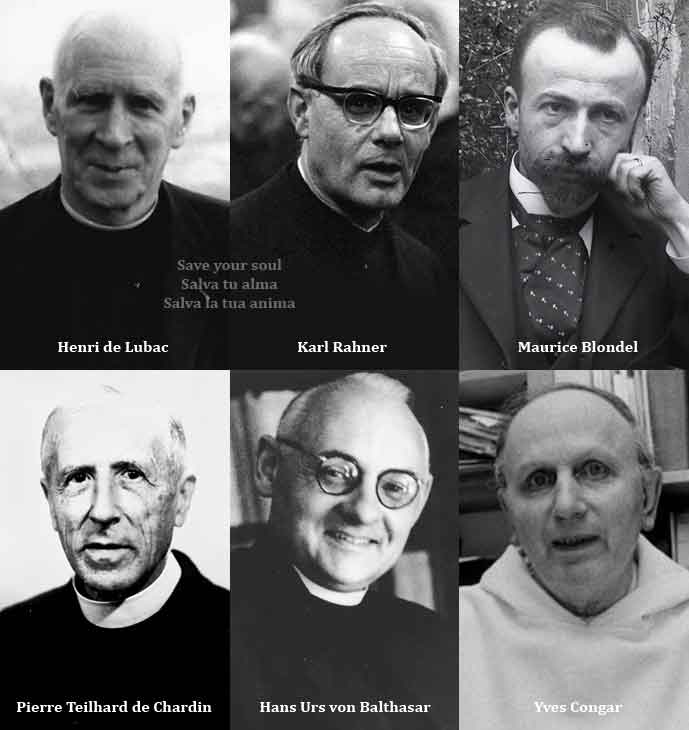
[They] had a considerable influence at the Council.
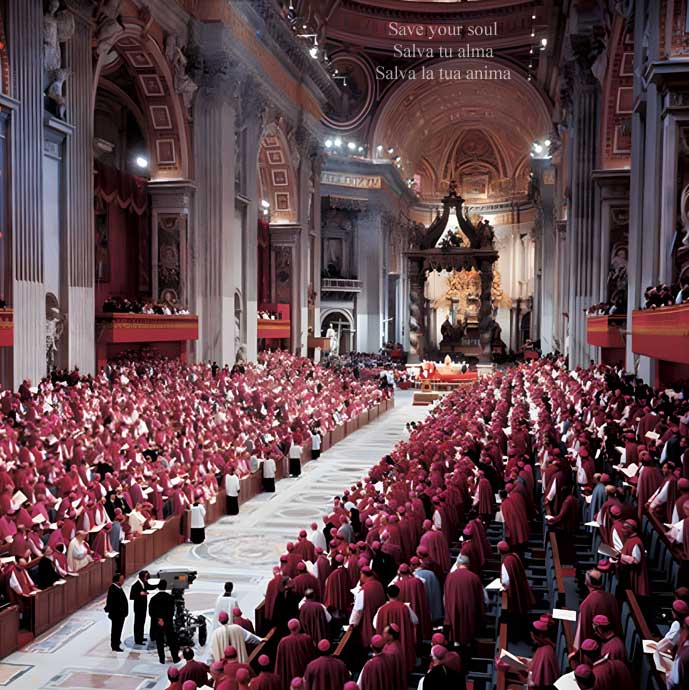
The change was such that Cardinal Suenens (1904–1996), moderator at the Council, declared with satisfaction:
“The Second Vatican Council is 1789 in the Church” [12].
Following this disastrous council—Vatican II—profound changes were made to the Catholic liturgy and the sacraments, making them acceptable to Protestant pastors.
Then came the schism between the multitude of Christians—Pelagianism, Manichaeism, Gnosticism, Arianism [13], etc.—who actively or passively followed the modernist movement imposed upon them, and those who wished to preserve Tradition, that is, the two-thousand-year-old religion handed down from the apostles.
The influence of modernist thought was decreed to be the official Catholic religion, and a considerable decline in religious practice ensued. Churches emptied, the number of religious vocations plummeted, convents and monasteries were sold, the number of priests dropped drastically, and the promised “new wind” resulted in the impoverishment of Catholic vitality and the end of the “missions” that had still been flourishing in the 19th century and the first half of the 20th.
To give a concrete example: in 1950, the number of ordinations in France was 1,000; in 2025, it was 90—a staggering drop of 91%. Less religious practice means less faith, hence fewer vocations.
“Every good tree bears good fruit, while a bad tree bears bad fruit. A good tree cannot bear bad fruit, nor can a bad tree bear good fruit. Every tree that does not bear good fruit is cut down and thrown into the fire. Thus, you will recognize them by their fruits” (Mt 7:17–20).
To put it more bluntly, I refer you to a song from 1970: “Il a dit la vérité, il doit être execute” (He spoke the truth; he must be executed – Guy Béart: “La vérité”) [14].
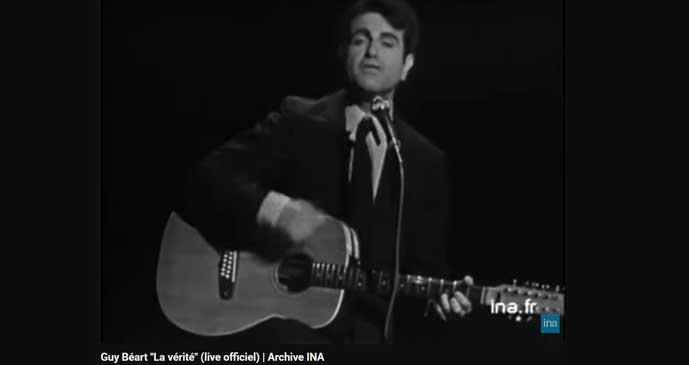
Thus, over time, all those who oppose the so-called “correct” version—the religiously correct, the politically correct, i.e., language intended to offend diverse sensibilities as little as possible—will be called upon to remain silent so that the truth does not shock error. This is how ecclesiastical leaders will invite or receive Protestants but not Catholics who have remained faithful to Catholic Tradition.
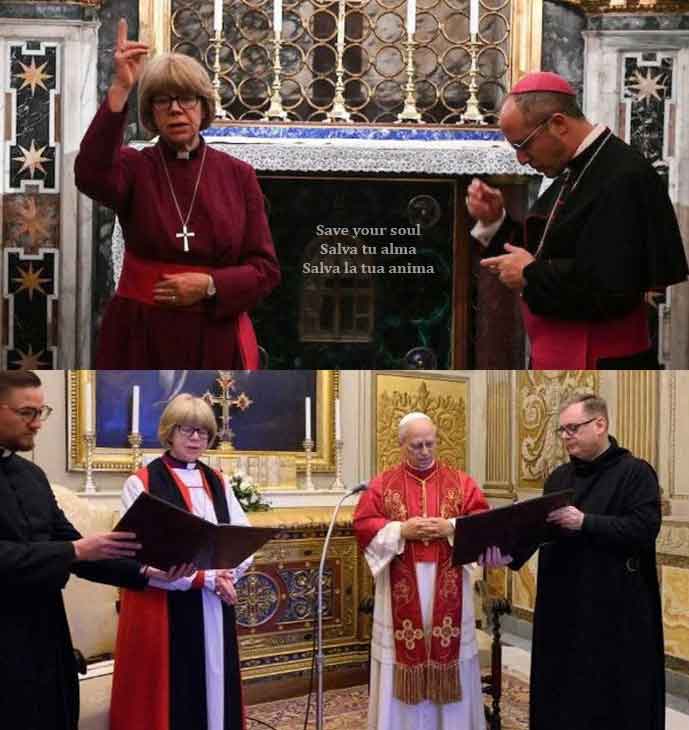
This is how a pope on an official visit will kiss the Quran…
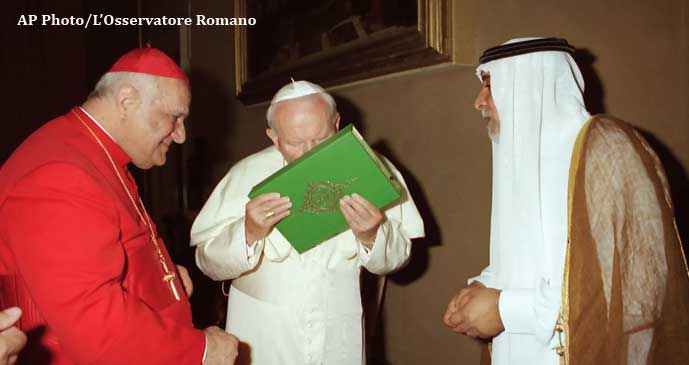
Pope John Paul II, center, kisses the the Quran, Islam’s Holy book, in this May 14, 1999 picture taken at Vatican City. Chaldean Patriarch Raphael I Bidawid at left. AP Photo/L’Osservatore Romano
Or receive a red mark on his forehead, the Tilak or Tika, a sign of recognition among worshippers of Shiva.
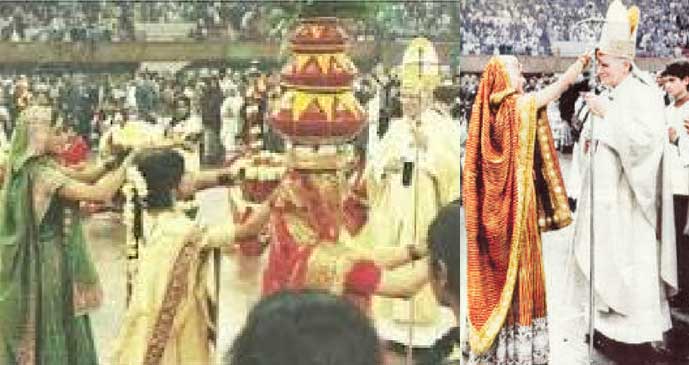
Pope John Paul II visited India February 1-10, 1986. The above picture, New Delhi’s Jawaharlal Nehru Stadium, of a woman applying tilak on the forehead of the Pope is sourced from The Hindu newspaper group’s “Frontline” magazine, Volume 16, n. 24.
These acts were considered gestures of politeness but, would I have agreed, during My time on earth, to politely bear upon Myself the mark of the demon?
For it is too often forgotten that pagan gods are demons—real and dangerous.
My Children, I, the Lord who speaks to you, call you to Me. I need you, your faithfulness, your love for the Truth, for I am the Way, the Truth, and the Life.
My Holy Spirit guides the Holy Church, My Bride, through the centuries but, could She (the Church) have been mistaken for twenty centuries in such a way that upholding Tradition would be a false path?
When I promised her divine help, I did not promise her the absence of temptation, but divine help to triumph over temptation. Pray, then, that [the Church] may overcome her temptations and remain faithful, or if She strays, that she may return to what she has always taught, always believed, and always defended.
My dearly beloved Children, I do not change and will never change. I will refute error and defend the Truth; I am God, and I created humanity for its beauty, for its holiness, for its love.
Be like Me and in My image: upright, just, and always active in defending the rights of God, My Heavenly Father, the Triune God, the eternal God.
I love you; I await you.
I bless you, in the Name of the Father, the Son, and the Holy Spirit (+). So be it.
Your Lord and Master, your God».
****
- The Great Schism of the Orthodox, on July 16, 1054, marks a significant division in Christianity, resulting in the separation between the Eastern Orthodox Church, led by the patriarch of Constantinople, Michael Cerularius and the Western Roman Catholic Church led by Pope Leo IX.
4 Key Causes of the Schism:
–Filioque Controversy: The Western Church added “filioque” (“and the Son”) to the Nicene Creed, stating that the Holy Spirit proceeds from both the Father and the Son. The Eastern Church rejected this addition, viewing it as an unauthorized change.
–Papal Authority: The Pope claimed supremacy over the entire Christian Church, while the Eastern Church favored a conciliar model of governance, emphasizing the importance of collective decision-making among bishops.
Ecclesiastical Differences:
–Liturgical Practices: Variations in worship, such as the use of unleavened bread in the Eucharist by the West and leavened bread by the East, highlighted the growing divide.
–Language in Worship: The Western Church primarily used Latin, while the Eastern Church used Greek, further contributing to misunderstandings and cultural differences.
. - Anglicanism, (also known as Episcopalianism in some countries), was born under the reign of King Henry VIII in the 16th century who pushed the Church of England to break with Rome, largely because Pope Clement VII refused to grant Henry an annulment of his marriage to Catherine of Aragon. Wishing no reform—except along the lines of Erasmus’s Christian humanism— King Henry VIII intended to replace Rome’s authority over the English church with his own. Upon Henry’s death, Archbishop Thomas Cranmer began changes that allied the Church of England with the Protestant Reformation. “The Book of Common Prayer” revised traditional forms of worship to incorporate Protestant ideas.
. - Martin Luther and John Calvin: Allies, Rivals, and Architects of the Protestant Reformation. The Reformation was not the work of one man but of many reformers whose ideas reshaped Christianity in Europe. Among them, Martin Luther and John Calvin stand as two of the most influential. Though they never met in person, their theological and historical legacies were deeply intertwined. Luther laid the groundwork for Protestant reform, while Calvin refined and systematized it.
. - The Council of Trent was a pivotal event of the Roman Catholic Church held from 1545 to 1563 in Trent, Italy, primarily to address the challenges posed by the Protestant Reformation and to clarify Catholic doctrine. It resulted in significant reforms within the Church and reaffirmed key Catholic teachings, including the importance of both faith and works for salvation. The Council of Trent is commonly regarded as the beginning of the Counter-Reformation.
. - The “Syllabus Errorum” (Compendium of Errors of the Present Time) is the name given to an index document issued by the Holy See under Pope Pius IX on 8 December 1864 at the same time as his encyclical letter Quanta cura. It collected a total of 80 propositions that the Pope considered to be current errors or heresies, pairing the briefest headings with references to the various documents where the actual teachings are found. The documents referenced by the Syllabus were intended to be a rebuttal of liberalism, modernism, moral relativism, secularization, and the political emancipation of Europe from the tradition of Catholic monarchies. The Syllabus is divided into ten sections on the following topics:
.
–Pantheism, naturalism, and absolute rationalism, §1–7
–Moderate rationalism, §8–14
–Indifferentism and latitudinarianism, §15–18
–Socialism, communism, secret societies, Bible societies, and liberal clerical societies, a general condemnation, unnumbered
–The Catholic Church and its rights (defending temporal power in the Papal States, overthrown six years later) §19–38
–Civil society and its relationship to the Catholic Church, §39–55
–Natural and Christian ethics, §56–64
–Christian marriage, §65–74
–The civil power of the Pope in the Papal States, §75–76
–Liberalism in every political form, §77–80
. - Humanum Genus (Human Kind) is a papal encyclical promulgated on 20 April 1884 by Pope Leo XIII. Released in the ascent of the industrial age, Marxism, and the aftermath of the September 20, 1870, Capture of Rome by the Kingdom of Italy military forces from the Papal States, “Humanum Genus” is principally a condemnation of Freemasonry. n this encyclical, Pope Leo XIII unmasks the diabolical activities of the freemasons who advance a program to utterly destroy the Catholic Church, under the deceitful cloak of promoting the good of humanity. The pope warns all Catholics and men of good will, especially political leaders, to shun freemasonry and their philosophies of naturalism.
. - Pascendi Dominici Gregis (Shepherding the Lord’s flock), is a papal encyclical issued by Pope Pius X on September 8, 1907, which condemns modernism in the Catholic Church, emphasizing the need to preserve traditional doctrines against evolving interpretations. It critiques the modernist movement for undermining the Church’s teachings by prioritizing subjective experience over objective truth. The encyclical led to the establishment of councils by bishops to address modernist influences in their dioceses. In “Pascendi Dominici Gregis”, Pope Pius X emphasizes the preservation of the Catholic Doctrine through the importance of maintaining established doctrines and resisting changes that modernist ideas might introduce. On the long-term, it has shaped the Church’s approach to modern philosophical and scientific developments, reinforcing the need to ground faith in traditional doctrines.
. - Mortalium Animos (The minds of mortals) is a 1928 papal encyclical by Pope Pius XI that addresses religious unity, emphasizing the Catholic Church as the one true Church founded by Jesus Christ. It rejects the idea that all religions are equally valid and condemns certain ecumenical movements ecumenical movements both past and present.
. - Humani Generis (The Human Race) is a papal encyclical that Pope Pius XII promulgated on 12 August 1950, “concerning some false new theories and opinions threatening to undermine the foundations of Catholic Doctrine”. It primarily discussed, the encyclical says, “new opinions” which may “originate from a reprehensible desire of novelty” and their consequences on the Church. The theological views and doctrines known as “New Theology” or “neo-modernism”, and their impact on the Catholic Church, are the main topics addressed. The theologies of the catholic priests, father Yves Congar and father Henri de Lubac, were particularly targeted. The study of “evolutionary theories” and their impact on theology constitute two of the 44 sections into which the encyclical is divided.
. - The Second Vatican Council, (1962–65), 21st ecumenical council of the Roman Catholic Church, announced by Pope John XXIII on January 25, 1959, as a means of spiritual renewal for the church and as an occasion for Christians separated from Rome to join in a search for Christian unity. Vatican II, as the council is also known, produced 16 documents that enacted many modernizing changes in the church according to the theme of “aggiornamento” (bringing up to date).
. - –Henri de Lubac (1896 –1991), was a French Jesuit priest and cardinal who is considered one of the most influential theologians of the 20th century. His writings and doctrinal research played a key role in shaping the Second Vatican Council.
–Karl Rahner (1904 –1984) was a German Jesuit priest and theologian. He is considered to be one of the most influential Catholic theologians of the 20th-century. Before the Second Vatican Council, Rahner worked alongside theologians associated with the emerging school of theological thought known as Nouvelle théologie. The Council was influenced by Rahner’s theology and his understanding of Catholic faith.
–Maurice Blondel (1861 –1949) was a French philosopher, whose most influential works, notably L’Action, aimed at establishing the correct relationship between autonomous philosophical reasoning and Christian belief.
–Pierre Teilhard de Chardin (1881 –1955) was a French Jesuit priest, scientist, paleontologist, philosopher, mystic, and teacher. Teilhard de Chardin investigated the theory of evolution, writing multiple scientific and religious works on the subject.
–Hans Urs von Balthasar (1905-1988) was a Swiss Catholic theologian and priest, widely regarded as one of the most important theologians of the 20th century. His work spanned multiple disciplines, including theology, philosophy, literature, and aesthetics.
–Yves Congar (1904-1995), a Dominican theologian has often been credited for his powerful influence at the Second Vatican Council. He was a member of the council’s preparatory commission at the explicit request of Pope John XXIII. And during the council itself, he was a member of several key committees, helping compose and edit eight major documents. But only recently did I realize Congar may have been a singular reason the council came to be in the first place.
. - The irreversible damage inflicted on the Catholic Church by the Second Vatican Council—whose aim was to modernize the Church and engage in dialogue with contemporary society—is comparable to that caused by the French Revolution of 1789, which profoundly altered the relationship between the Church and modern political states.
. - –Pelagianism is a heretical doctrine that arose within Christianity, according to which original sin was borne solely by the first parents, not by their descendants, and did not taint human nature, which certainly suffered only its consequences. The consequence is that, according to this doctrine, the human will alone is capable of choosing and doing good, without the need for divine grace.
–Manichaeism is an ancient dualistic religion founded by the Persian prophet Mani in the 3rd century AC, which teaches that the universe is a battleground between the forces of good (light) and evil (darkness). It spread widely across the Roman Empire and into Asia, influencing various religious and philosophical traditions.
–Gnosticism is a collection of religious and philosophical ideas that emerged in the early centuries of Christianity, emphasizing personal spiritual knowledge (gnosis) over religious authority. It typically views the material world as flawed, created by a lesser deity known as the demiurge, and believes that salvation comes through mystical insight into a higher divine reality.
–Arianism is a Christological doctrine that teaches Jesus was created by God and is distinct from God, rejecting the traditional notion of the Trinity. It was founded by Arius in the early 4th century and is considered heretical by the Catholic Church.
. - Guy Béart “La vérité” (live officiel) | Archive INA
https://www.youtube.com/watch?v=AfpSRnahQig
Source: https://srbeghe.blog/


 God the Father: «


 "If you knew how you shine after duly approaching the Sacrament of Confession. "Jesus is in the Confessional and He hears every word, sees into every corner of your heart and Is eager to bestow the graces inherent in His Forgiveness.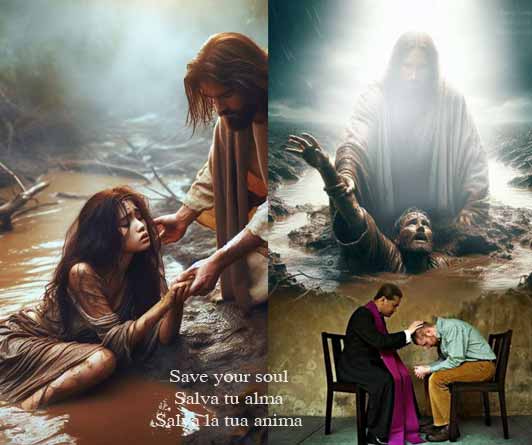
 "I ask to end to this abomination! No more of extraordinary Ministers of the Eucharist, no more of Communions in the hand!"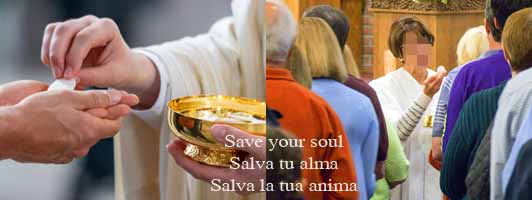
 "Oh Jesus of Divine Mercy, hear my pleadings to you, for I am here to do your Will!"
 "I place myself in the presence of the Most Holy Trinity (Father, Son, and Holy Spirit) and by the power of the Blood of Our Lord Jesus Christ, I break, undo, trample, annihilate, render ineffective, and erase from my physical, psychic, biological, and spiritual being every curse that has been placed on me, on my family and family tree, on any person, family member, or ancestor through acts of occultism or spiritism. By the power of the Precious Blood of Our Lord Jesus Christ and through the intercession of the Blessed Virgin Mary, St. Michael, St. Gabriel, and St. Raphael, I break and render ineffective every curse, whatever its nature, in the Name of our Lord Jesus Christ. Amen (Repeat the prayer 3 times)"
  "O glorious St. Joseph! by your profound humility, by your unalterable meekness, by your invincible patience, by your angelic purity and perfect fidelity that made you a timely imitator of the virtues of Jesus and Mary, I ask you to console me in all my sorrows, to guide me in all my doubts, to defend me in all temptations, to deliver me from all spiritual and material dangers; to extend your arm against all my visible and invisible enemies, breaking and destroying all the snares and barriers that they tend and arm against me. Amen."
  "Oh, blessed Saint Michael, protect us from the attacks and snares of the evil spirits because you know full well that we are poor mortals, fragile and weak, in need of the Mercy of God and of your protection to fulfill the mission that Heaven has commissioned to us. Oh, Saint Michael, may your victorious cry: “who is like God? no one is like God”, suppress and cast into Hell satan and all the evil spirits who prowl about the world seeking the destruction of souls. Amen"
 Come, Holy Spirit, send to us from Heaven a ray of your light. Come, Father of the poor, come, giver of gifts, come, light of hearts. Perfect comforter, sweet guest of the soul, sweetest relief. In toil, rest, in heat, shelter, in weeping comfort. O most blessed light, invade into the depths the hearts of your faithful. Without your strength nothing is in man, nothing is without fault. Wash what is sordid, bathe what is parched, heal what bleeds. Bend that which is stiff, warm that which is icy, straighten that which is astray. Give to your faithful who trust in you alone your Holy Gifts. Give virtue and reward, give holy death, give eternal joy. Amen.
 "O Hearts of Jesus and Mary; I consecrate myself, I consecrate my family and the whole world, to your Most Beloved Hearts. Listen to the supplication which I making to you and accept our hearts in Yours, to be delivered and protected we, the whole world, from all evil and all sin. May the protection of your Two Hearts be refuge, strength, and protection, in the daily spiritual struggles. That the power of your Two Hearts irradiates the world so that it is protected from evil and sin. We willingly consecrate ourselves and consecrate all mankind to your Hearts; sure and confident, for your Great Mercy, to obtain the victory over the forces of evil in this world, and the eternal Glory in the Kingdom of God. Amen"